Wednesday, June 11, 2014
The Greatest American ___ Hero ___ Traitor (choose one)
I hope someday to be able to use this in a classroom to introduce a unit on Benedict Arnold....

Wednesday, June 4, 2014
Finding Mrs. Warnecke

Sometimes you read a book or encounter a story that just makes you want to run out and do something. I read a book like that this week. It's Finding Mrs. Warnecke, a book by a North Carolina Teacher of the Year (2008) and National Teacher of the Year finalist (2009).
In this memoir of sorts, Cindi Rigsbee
shares her progression from a first-grade classroom in which she received warm
encouragement, to her own classrooms as a teacher and the ways she developed
that same encouragement for her students.
She shares specific techniques for
relating to students (and not) and tells of both successes and failures in her
growth as an educator. She relates everything to the relationship she had with
her first-grade teacher, Barbara Warnecke, and how that relationship helped her
at every stage of her life. The book ends with the account of her meeting Warnecke as an adult and how their friendship continued on a new plane.
The relationship between a
caring teacher and a willing student is probably the greatest baton-passing
combination we humans have. Whether in a classroom or in a home between parent and
child, this connection of love and respect produces incalculable positive
results.
As my teacher training
progresses, I’m struck by the gap between what I expected to learn and what
I’m learning. I expected to hear about techniques, magic words that will
transfer information from teacher to student. I expected matter-of-fact
checklists that would equip me to lead a classroom.
But what I’m hearing
repeatedly, and across disciplines, is an emphasis on person-to-person,
questioning, open-ended relationships in which a seasoned traveler invites a
novice to join him or her on the road.
This is encouraging. Hearing
that a simple act like validating a bit of rhyme by a first-grader made the
difference for a lifetime means I already possess key tools for education: the
abilities to listen, observe, care, pause, encourage, guide. These qualities I
already have, should I choose to use them.
As Rigsbee says, the
awareness and sensitivity to students’ needs and situations trumps any kind of
academic technique or procedure. When I read that she encountered students who disrupted
class because a father died or a mother left the night before, I’m reminded of
students who acted out in class while I was a substitute teacher this spring.
Were any of those children
newly missing a parent? Were they hit or threatened or denied food or forced to
leave home the night before? I need to remember to look past behavior and into
heart issues before making decisions or taking action.

I had a Mrs. Warnecke too...only her name was Nannie Rucker. I know now she was the first black woman to be a Tennessee delegate to the 1972 Democratic National Convention, but all I knew then was that my wonderful first-grade teacher came to my house for dinner.
She loved and encouraged me, then and now. I attended her funeral years ago and despite the crowd, felt as though I knew her best. What a great legacy she and Mrs. Warnecke have left, and who knows how far the ripples go?
Sunday, June 1, 2014
The Development of Superman

But even Superman started out as Superboy, growing up and developing a sense of identity and responsibility. This week, as part of a Learning and Teaching class, my group took a look at the various stages of emotional and moral development that all children go through. Different rates, yes, but identical stages. We decided to apply these to Superman for a creative project.
He is invulnerable and can fly, burn with his vision and freeze with his breath, lift cars and see through walls...but as it turns out, Superman is just like me. And you.
He came to a sense of himself, obeyed rules for others' sake, then chose to obey them for his own sake, then developed a moral code that he chooses to stick to.
Oh, and hey. We both wear glasses and were journalists. All part of the process.

These are the stages of moral development as put forth by Lawrence Kohlberg. Our group also tackled the eight stages of development according to Erik Erikson:


Thursday, May 29, 2014
Concept Mapping
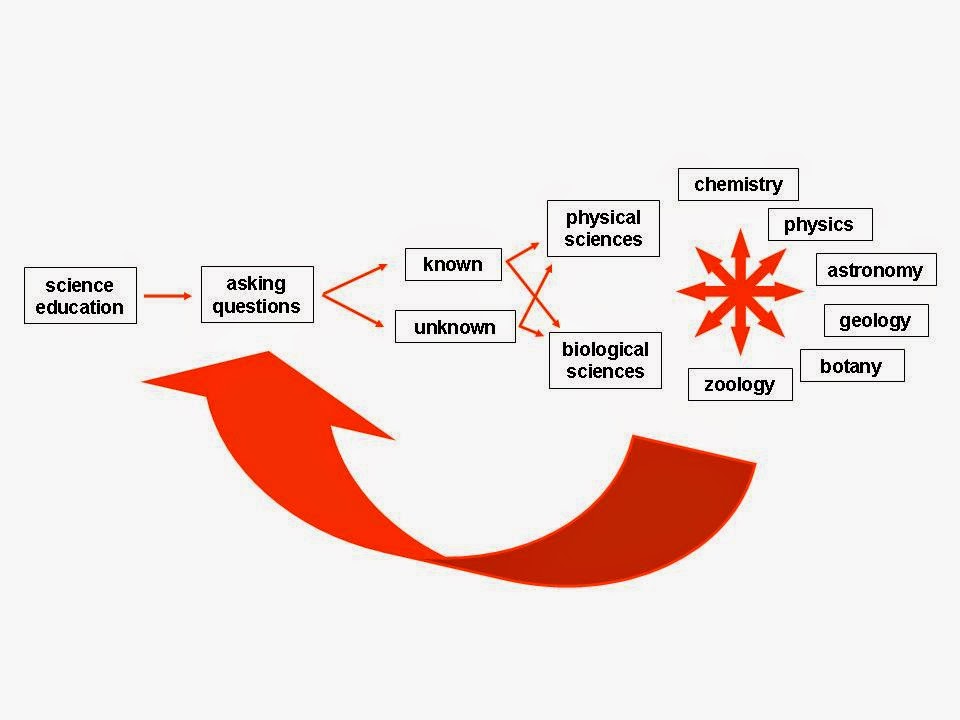
Science used to be, for myself, a collection of facts. Facts about planets and plants and everything in between, but without connections between them.
 Science is no longer something to fear or look askance at. It is something to explore...something deep and big and unknowable; and yet, we want to know and so we keep asking questions.
As I complete my first class of graduate school, Teaching Science, I'm realizing what a journey it is to be a scientist. You ask questions, seek answers, learn information, and then you're right back asking more questions.
The physical sciences overlap with biological sciences: how do chemicals affect the human body? Astronomy overlaps with biology: global warming. These are not discrete lists of facts; they are interconnected webs that raise as many questions as they do answers.
I was asked to create concept maps, bookending this course. Here they are, in all their shiny-faced, future-science-teacher glory.
A list of unrelated topics vs. an interconnected cycle of Q&A...together representing the journey of one man learning science, as he learns how to teach it.
Wednesday, May 28, 2014
It Lies in the Brain
Ethics and morals form the backbone of our social institutions. The rule of law. Oaths taken by public officials and private citizens in court. Rules against plagiarism. Bank teller jobs. Police investigations. Fourth-grade test-taking procedures.
So when people don't, or can't, tell the truth, we call them pathological liars. They lie to others and they lie to themselves. It's deception of the highest -- or lowest -- order.
Recently, Radiolab -- a public radio exploration of intriguing issues -- aired a program called Deception. It explained how research into lying is revealing intriguing things about the human brain.
A researcher took temp job applications from 108 people and asked them questions about their histories. She then checked into the histories and found that 12 of them had substantial discrepancies in their stories. She invited them all to come in for brain scans...and all 108 did.
She expected to find more gray matter in the brain and less so-called "white matter." The white matter is in the prefrontal cortex...the part of the brain right behind the forehead. Surely, someone who lies constantly, regularly, creatively, and often needlessly must have fewer connections with other parts of the brain. Surely, there must be something lacking. Surely, pathological liars are, in essence, brain-damaged.
That's not what she found.
She found 25% more white matter. More connections. Faster thinking. More interrelation between sections of the brain and an increased ability to put things together, fast.
She experimented and failed to find what she was after. But she found something more interesting.
Someday, when I'm an educator, I want to help my students learn that being wrong is not just OK, it's necessary and beneficial.
No lie.

So when people don't, or can't, tell the truth, we call them pathological liars. They lie to others and they lie to themselves. It's deception of the highest -- or lowest -- order.
Recently, Radiolab -- a public radio exploration of intriguing issues -- aired a program called Deception. It explained how research into lying is revealing intriguing things about the human brain.
A researcher took temp job applications from 108 people and asked them questions about their histories. She then checked into the histories and found that 12 of them had substantial discrepancies in their stories. She invited them all to come in for brain scans...and all 108 did.
She expected to find more gray matter in the brain and less so-called "white matter." The white matter is in the prefrontal cortex...the part of the brain right behind the forehead. Surely, someone who lies constantly, regularly, creatively, and often needlessly must have fewer connections with other parts of the brain. Surely, there must be something lacking. Surely, pathological liars are, in essence, brain-damaged.
That's not what she found.
She found 25% more white matter. More connections. Faster thinking. More interrelation between sections of the brain and an increased ability to put things together, fast.
She experimented and failed to find what she was after. But she found something more interesting.
Someday, when I'm an educator, I want to help my students learn that being wrong is not just OK, it's necessary and beneficial.
No lie.
Deliberate Misconceptions
 Well, after ten days in a fast-paced Teaching Science class at MTSU, there's a lot rolling around in my head. Ideas for a future classroom...ways to encourage discussion and questions instead of rote answers...assessing prior knowledge.
 That last one's pretty interesting. We all have misconceived ideas about how things work or why they exist as they do. Some people think seasons are a result of the Earth's orbit around the sun. Some people think an unopened bottle of soda goes flat if you refrigerate it and then let it return to room temperature. Others think mushrooms are plants, or that nuts aren't fruits.
As a future educator, it will be partly my responsibility to dispel misconceptions, or alternate conceptions, as they're now referred to. I'll need to do it by guiding my students to the truth, not by simply telling them facts.
But, you know, sometimes a good misconception is worth having around. Like the April Fool's stories broadcast on NPR. Thousands of listeners eagerly tune in on April 1 each year, ready to be happily fooled. The stories -- all capitalizing on misconceptions -- never fail to disappoint.

Here are three of my favorite science-related misconceptions from this collection. Read or listen, and don't search for the truth.
Exploding trees!
Eye surgery for 3-D vision!
Danger! Dihydrogen Monoxide!
2014 Science Fair at the White House
Set aside the tri-fold presentation boards and the PowerPoint presentations on laptops. Today's 2014 White House Science Fair features young academics and researchers who are tackling some big projects, using up-to-the-minute technology to make it happen.
From prosthetic limbs to galaxy clusters, from disease research to autism and solar power, these young scientists are testing boundaries.
-- lab leftovers becoming solar power generators
-- new information about dark matter
-- a vibrating bracelet to help autistic children manage ritual behaviors
-- a prosthetic leg from recycled tires and zip-ties, for use in developing countries
-- an alarm that sounds when cars grow too hot for humans or animals
-- an environmentally friendly solar cell
-- partnering with earthworms to reduce carbon emissions
-- stem-cell research against adult brain cancer
-- pedestrian safety systems in Africa
 ...and more.
At a time when many students use iPhones to watch cat videos and the Web strictly for entertainment, it's encouraging to see what students are doing with technology.
Wouldn't it be great to explore with our students what other young people are doing in labs worldwide? Many of them used only materials that nearly everybody has access to (recycled materials, computers and curiosity). What other scientific breakthroughs could we encourage? Maybe one of our students could be at the White House Science Fair someday....
From prosthetic limbs to galaxy clusters, from disease research to autism and solar power, these young scientists are testing boundaries.
-- lab leftovers becoming solar power generators
-- new information about dark matter
-- a vibrating bracelet to help autistic children manage ritual behaviors
-- a prosthetic leg from recycled tires and zip-ties, for use in developing countries
-- an alarm that sounds when cars grow too hot for humans or animals
-- an environmentally friendly solar cell
-- partnering with earthworms to reduce carbon emissions
-- stem-cell research against adult brain cancer
-- pedestrian safety systems in Africa
At a time when many students use iPhones to watch cat videos and the Web strictly for entertainment, it's encouraging to see what students are doing with technology.
Wouldn't it be great to explore with our students what other young people are doing in labs worldwide? Many of them used only materials that nearly everybody has access to (recycled materials, computers and curiosity). What other scientific breakthroughs could we encourage? Maybe one of our students could be at the White House Science Fair someday....
Subscribe to:
Comments (Atom)