Showing posts with label learning. Show all posts

Sunday, June 1, 2014

The Development of Superman


Eight-year-old boy, bath towel and safety pin, old stump: prescription for flight. If only I'd been born on Krypton. Superman never had to pretend; he was the guy that all of us superhero-wannabes wannabe.

But even Superman started out as Superboy, growing up and developing a sense of identity and responsibility. This week, as part of a Learning and Teaching class, my group took a look at the various stages of emotional and moral development that all children go through. Different rates, yes, but identical stages. We decided to apply these to Superman for a creative project. 

He is invulnerable and can fly, burn with his vision and freeze with his breath, lift cars and see through walls...but as it turns out, Superman is just like me. And you.

He came to a sense of himself, obeyed rules for others' sake, then chose to obey them for his own sake, then developed a moral code that he chooses to stick to. 

Oh, and hey. We both wear glasses and were journalists. All part of the process.


These are the stages of moral development as put forth by Lawrence Kohlberg. Our group also tackled the eight stages of development according to Erik Erikson:


Thursday, May 29, 2014

Concept Mapping

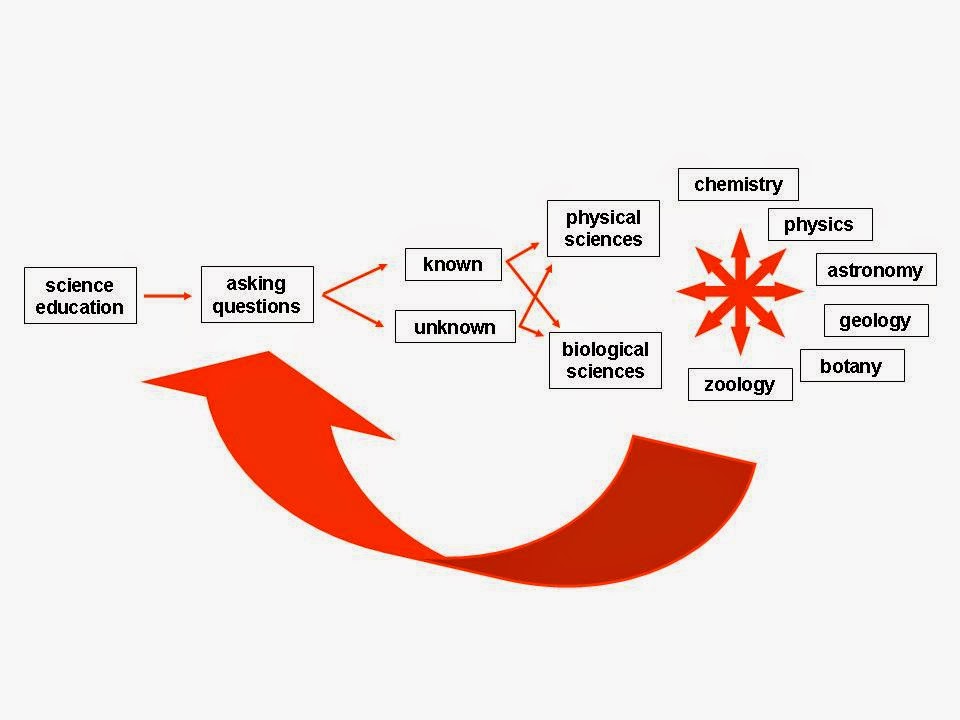
Science used to be, for myself, a collection of facts. Facts about planets and plants and everything in between, but without connections between them. 

As I complete my first class of graduate school, Teaching Science, I'm realizing what a journey it is to be a scientist. You ask questions, seek answers, learn information, and then you're right back asking more questions. 

The physical sciences overlap with biological sciences: how do chemicals affect the human body? Astronomy overlaps with biology: global warming. These are not discrete lists of facts; they are interconnected webs that raise as many questions as they do answers. 

Science is no longer something to fear or look askance at. It is something to explore...something deep and big and unknowable; and yet, we want to know and so we keep asking questions. 

I was asked to create concept maps, bookending this course. Here they are, in all their shiny-faced, future-science-teacher glory. 

A list of unrelated topics vs. an interconnected cycle of Q&A...together representing the journey of one man learning science, as he learns how to teach it.


Wednesday, May 28, 2014

It Lies in the Brain

Ethics and morals form the backbone of our social institutions. The rule of law. Oaths taken by public officials and private citizens in court. Rules against plagiarism. Bank teller jobs. Police investigations. Fourth-grade test-taking procedures. 

So when people don't, or can't, tell the truth, we call them pathological liars. They lie to others and they lie to themselves. It's deception of the highest -- or lowest -- order. 

Recently, Radiolab -- a public radio exploration of intriguing issues -- aired a program called Deception. It explained how research into lying is revealing intriguing things about the human brain. 

A researcher took temp job applications from 108 people and asked them questions about their histories. She then checked into the histories and found that 12 of them had substantial discrepancies in their stories. She invited them all to come in for brain scans...and all 108 did. 

She expected to find more gray matter in the brain and less so-called "white matter." The white matter is in the prefrontal cortex...the part of the brain right behind the forehead. Surely, someone who lies constantly, regularly, creatively, and often needlessly must have fewer connections with other parts of the brain. Surely, there must be something lacking. Surely, pathological liars are, in essence, brain-damaged. 

That's not what she found. 

She found 25% more white matter. More connections. Faster thinking. More interrelation between sections of the brain and an increased ability to put things together, fast. 

She experimented and failed to find what she was after. But she found something more interesting. 

Someday, when I'm an educator, I want to help my students learn that being wrong is not just OK, it's necessary and beneficial. 

No lie.

2014 Science Fair at the White House

Set aside the tri-fold presentation boards and the PowerPoint presentations on laptops. Today's 2014 White House Science Fair features young academics and researchers who are tackling some big projects, using up-to-the-minute technology to make it happen. 

From prosthetic limbs to galaxy clusters, from disease research to autism and solar power, these young scientists are testing boundaries. 

-- lab leftovers becoming solar power generators
-- new information about dark matter
-- a vibrating bracelet to help autistic children manage ritual behaviors
-- a prosthetic leg from recycled tires and zip-ties, for use in developing countries
-- an alarm that sounds when cars grow too hot for humans or animals
-- an environmentally friendly solar cell
-- partnering with earthworms to reduce carbon emissions
-- stem-cell research against adult brain cancer
-- pedestrian safety systems in Africa

...and more.

At a time when many students use iPhones to watch cat videos and the Web strictly for entertainment, it's encouraging to see what students are doing with technology. 

Wouldn't it be great to explore with our students what other young people are doing in labs worldwide? Many of them used only materials that nearly everybody has access to (recycled materials, computers and curiosity). What other scientific breakthroughs could we encourage? Maybe one of our students could be at the White House Science Fair someday....

Sunrise, Sunset


As I sit here, the sun has been streaming in my palladian window, bathing me in bright rays. Too bright at times, and I keep moving a bit to get the light out of my eyes. But the sun has moved on now and there's light on the floor in front of me, but it's out of my way. 

If people in the ancient world had blogged, somebody could have written that. And it's something we would still say today. But why? We know it's the Earth that moves, not the sun. Why do we persist in referring to the sunrise, the sunset, the sun moving across the sky?

Perspective is everything in life: the way we interact with people, the decisions we make, the understanding we develop...it all depends on perspective. 

Should we use different language in the science classroom to reflect scientific fact? Sunrise could be Earth-down. Sunset could be Earth-up

So much depends on perspective. Even colors are subjective; we take it for granted that everyone sees colors the same way. Sounds? I've sometimes wondered while in a crowded auditorium, if we all hear exactly the same tones of voice or music. Does the opening chord of Bach's famous Toccata and Fugue feel exactly the same to everyone?

Height is a major perspective to consider. I'm 6'5" and I am comfortable leaning on the top of a refrigerator (you need to clean up there, by the way). The students I encounter in the classroom always ask how tall I am (one inch taller than Abraham Lincoln, I always say, and then somebody always mentions the top hat. I may have to start wearing one.).

I take my perspective for granted. But perhaps I should get on my knees occasionally and see the world from the height of a third-grader. And maybe a third-grader should stand on a desk to see my viewpoint. 

The sun moves, and the sun never moves. Perspective. How very much we all have to learn.

Tuesday, May 27, 2014

Romeo, Juliet and Aerodynamics

One of the educational terms I'm learning about is "learning progression": the carefully crafted strategy of deciding what children should learn in a particular subject by a certain grade, and then developing ways to introduce and reinforce those concepts at various grade levels. 

The instruction is simple at first and grows more complex with students' abilities. This is familiar to everyone; we all know math is easier in first grade than in fifth. 

But an interesting angle of this is that a teacher can teach advanced and complicated information without calling it what it is. 

As my textbook says, you can teach atomic molecular theory without ever using the words atomic, molecular or theory

Which got me thinking: how many times are students scared away from interesting topics because of name and reputation?

Shakespeare alluded to this in Act II, scene ii of Romeo and Juliet when he wrote that a rose smells like and is a rose, no matter what we call it (though he said it better!).

Third-graders can learn aerodynamics by making paper airplanes, but they're just having fun. Later, the word "fun" changes to "aerodynamics"; and wouldn't you prefer to realize you'd been learning it all along, only without the label?

Wednesday, May 21, 2014

Talk and Argue


Talk and argument – common words in everyday events, but with uncommon meanings in the science classroom.

“Talk” is often something teachers don’t want. “Stop talking.” “Don’t talk.” The implication is that the student simply needs to listen and absorb what the teacher says.

“Argument” happens in an arena, a combative venue. There’s a winner and a loser. The argument is designed for one to prevail over the other.


But in an inquiry-based classroom, talk and argument are desirable parts of the process. “Talk” means to explore assumptions and new information for accuracy and understanding. It's exploration…searching for something not known.

“Argument” (or argumentation) means to lay out contexts, information new and old, and welcomes participation by all. Newbies are welcome; science advances nowhere if only the long-credentialed are heard.

Most traditional classrooms use what’s been called the I.R.E. approach – the teacher Initiates, the student Responds, and the teacher Evaluates.

“What is water made of?”

“Hydrogen and oxygen.”

“Yes.”

This approach might seem to work when dealing with known facts and tables. But it limits the student to what the teacher knows and approves of. Instead of a horizon, there’s a wall.

In an inquiry-based classroom, using scientific talk and argument means the teacher guides the discussion, not approves or disapproves of the information spoken.

“Let me see if I understand. You said….”

“Does anyone agree or disagree?

“Can you tell me more?”

There’s always room for correction; after all, no matter how earnest the discussion, a water molecule doesn’t contain nitrogen. But instead of announcing that fact, the teacher can steer the exploration so the students find out for themselves.
Often, I think, teachers use the I.R.E. approach because it’s efficient.

“Yes.” “No.” “Usually.” “No.” “Yes.”

But if the ultimate luxury is time, then teachers owe it to their students to be inefficient, lavishing time on them, so they discover for themselves.

Teachers need to wait.

And wait.

Hear the wheels turn.

And wait a bit more.

Humans don’t learn to walk in a day, or to build a car in a week. It takes time to reflect, explore, accept and reject, and move on.

So, as I purpose and prepare to teach, I need to steer away from the efficient and what I've always thought of as desirable. Slow down, David, and bring on the talk and arguments.

Tuesday, May 13, 2014

Orion

Each year in winter, I receive a visitor. He's a rather flashy dresser, best known for his jeweled belt, which he wears everywhere. It easily catches my eye every time I see him. Three sparkling beacons, and I know he's there. His name is Orion, and he's a hunter, which is odd for a guy who has such a distinctive sense of fashion.

Orion is, of course, a constellation...stars hanging in space with no relationship to each other except the connections which my eye provides. From where I stand, breath hanging in the cold air, there's the belt...then his body, arm raised, warding off a wild animal or aiming a bow or wielding a shield, depending on the lore I read. 

Orion doesn't move or change, or at least he hasn't in my lifetime. He's predictable and consistent and obvious. He's a given, a known quantity. I can take him for granted. 
Or can I?

I'm a new graduate student, leaving behind two other careers to train for a third. I want to be a teacher, an expander of minds, an introducer of new things. But if I'm going to teach, first I have to learn, and then I'll learn again through teaching. And before I can learn, I need to unlearn. 

So, the first step is admitting that Orion isn't Orion. 

Orion is a collection of individual gassy flames, long distances from each other and my eyes. Because I see the sky as flat, the stars that make up his skeleton appear as bright dots on black velvet, arranged conveniently for my brain to recognize. 

But if I could leave Earth and travel to a point 90 degrees away from my current vantage point, I would no longer see Orion's belt, or Orion himself. Oh, the stars would still be there, but the three in a row that make up that beautiful belt would be scattered, because they're not lined up beside each other. 

Maybe I would see new constellations. Is one of Orion's belt stars now the ear of a fox? Maybe the tip of his bow becomes the foot of a satyr. Perhaps his stars, appearing together on a flat sky for me, are actually so far apart they're not even visible together in someone else's sky.

I have to say goodbye to what I know now in order to see something new. I have to unlearn to learn. 

Science, I think, is like this. We know lots of facts. We know there are facts we don't know. And we know things we don't realize we know.

But that fourth quadrant...that's the biggie. We don't know what we don't know. We don't know how much there is that we don't know. That's why we explore and change and correct and re-guess and give up and try again. Because there's so much we don't know. 

And it's the same with history. Dates, places, people...yes. Understanding why...no. 

Math: so much unknown beyond so much known. 

Music: a finite number of notes yielding an infinite number of patterns and new sounds. 

So many subjects to unlearn, and learn, and teach, and learn again. 

Let's get started.