Showing posts with label science. Show all posts

Thursday, May 29, 2014

Concept Mapping

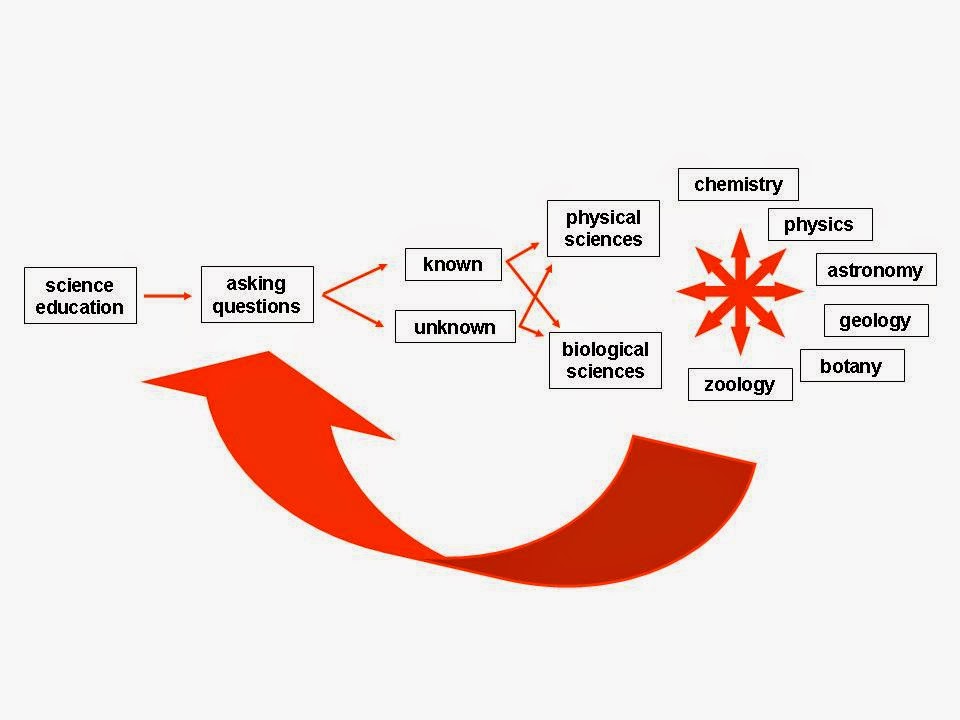
Science used to be, for myself, a collection of facts. Facts about planets and plants and everything in between, but without connections between them. 

As I complete my first class of graduate school, Teaching Science, I'm realizing what a journey it is to be a scientist. You ask questions, seek answers, learn information, and then you're right back asking more questions. 

The physical sciences overlap with biological sciences: how do chemicals affect the human body? Astronomy overlaps with biology: global warming. These are not discrete lists of facts; they are interconnected webs that raise as many questions as they do answers. 

Science is no longer something to fear or look askance at. It is something to explore...something deep and big and unknowable; and yet, we want to know and so we keep asking questions. 

I was asked to create concept maps, bookending this course. Here they are, in all their shiny-faced, future-science-teacher glory. 

A list of unrelated topics vs. an interconnected cycle of Q&A...together representing the journey of one man learning science, as he learns how to teach it.


Wednesday, May 28, 2014

It Lies in the Brain

Ethics and morals form the backbone of our social institutions. The rule of law. Oaths taken by public officials and private citizens in court. Rules against plagiarism. Bank teller jobs. Police investigations. Fourth-grade test-taking procedures. 

So when people don't, or can't, tell the truth, we call them pathological liars. They lie to others and they lie to themselves. It's deception of the highest -- or lowest -- order. 

Recently, Radiolab -- a public radio exploration of intriguing issues -- aired a program called Deception. It explained how research into lying is revealing intriguing things about the human brain. 

A researcher took temp job applications from 108 people and asked them questions about their histories. She then checked into the histories and found that 12 of them had substantial discrepancies in their stories. She invited them all to come in for brain scans...and all 108 did. 

She expected to find more gray matter in the brain and less so-called "white matter." The white matter is in the prefrontal cortex...the part of the brain right behind the forehead. Surely, someone who lies constantly, regularly, creatively, and often needlessly must have fewer connections with other parts of the brain. Surely, there must be something lacking. Surely, pathological liars are, in essence, brain-damaged. 

That's not what she found. 

She found 25% more white matter. More connections. Faster thinking. More interrelation between sections of the brain and an increased ability to put things together, fast. 

She experimented and failed to find what she was after. But she found something more interesting. 

Someday, when I'm an educator, I want to help my students learn that being wrong is not just OK, it's necessary and beneficial. 

No lie.

Deliberate Misconceptions

Well, after ten days in a fast-paced Teaching Science class at MTSU, there's a lot rolling around in my head. Ideas for a future classroom...ways to encourage discussion and questions instead of rote answers...assessing prior knowledge. 

That last one's pretty interesting. We all have misconceived ideas about how things work or why they exist as they do. Some people think seasons are a result of the Earth's orbit around the sun. Some people think an unopened bottle of soda goes flat if you refrigerate it and then let it return to room temperature. Others think mushrooms are plants, or that nuts aren't fruits.

As a future educator, it will be partly my responsibility to dispel misconceptions, or alternate conceptions, as they're now referred to. I'll need to do it by guiding my students to the truth, not by simply telling them facts. 

But, you know, sometimes a good misconception is worth having around. Like the April Fool's stories broadcast on NPR. Thousands of listeners eagerly tune in on April 1 each year, ready to be happily fooled. The stories -- all capitalizing on misconceptions -- never fail to disappoint. 

Here are three of my favorite science-related misconceptions from this collection. Read or listen, and don't search for the truth. 

Exploding trees!

Eye surgery for 3-D vision!

Danger! Dihydrogen Monoxide!


2014 Science Fair at the White House

Set aside the tri-fold presentation boards and the PowerPoint presentations on laptops. Today's 2014 White House Science Fair features young academics and researchers who are tackling some big projects, using up-to-the-minute technology to make it happen. 

From prosthetic limbs to galaxy clusters, from disease research to autism and solar power, these young scientists are testing boundaries. 

-- lab leftovers becoming solar power generators
-- new information about dark matter
-- a vibrating bracelet to help autistic children manage ritual behaviors
-- a prosthetic leg from recycled tires and zip-ties, for use in developing countries
-- an alarm that sounds when cars grow too hot for humans or animals
-- an environmentally friendly solar cell
-- partnering with earthworms to reduce carbon emissions
-- stem-cell research against adult brain cancer
-- pedestrian safety systems in Africa

...and more.

At a time when many students use iPhones to watch cat videos and the Web strictly for entertainment, it's encouraging to see what students are doing with technology. 

Wouldn't it be great to explore with our students what other young people are doing in labs worldwide? Many of them used only materials that nearly everybody has access to (recycled materials, computers and curiosity). What other scientific breakthroughs could we encourage? Maybe one of our students could be at the White House Science Fair someday....

Sunrise, Sunset


As I sit here, the sun has been streaming in my palladian window, bathing me in bright rays. Too bright at times, and I keep moving a bit to get the light out of my eyes. But the sun has moved on now and there's light on the floor in front of me, but it's out of my way. 

If people in the ancient world had blogged, somebody could have written that. And it's something we would still say today. But why? We know it's the Earth that moves, not the sun. Why do we persist in referring to the sunrise, the sunset, the sun moving across the sky?

Perspective is everything in life: the way we interact with people, the decisions we make, the understanding we develop...it all depends on perspective. 

Should we use different language in the science classroom to reflect scientific fact? Sunrise could be Earth-down. Sunset could be Earth-up

So much depends on perspective. Even colors are subjective; we take it for granted that everyone sees colors the same way. Sounds? I've sometimes wondered while in a crowded auditorium, if we all hear exactly the same tones of voice or music. Does the opening chord of Bach's famous Toccata and Fugue feel exactly the same to everyone?

Height is a major perspective to consider. I'm 6'5" and I am comfortable leaning on the top of a refrigerator (you need to clean up there, by the way). The students I encounter in the classroom always ask how tall I am (one inch taller than Abraham Lincoln, I always say, and then somebody always mentions the top hat. I may have to start wearing one.).

I take my perspective for granted. But perhaps I should get on my knees occasionally and see the world from the height of a third-grader. And maybe a third-grader should stand on a desk to see my viewpoint. 

The sun moves, and the sun never moves. Perspective. How very much we all have to learn.

Tuesday, May 27, 2014

Joyful Noise

The songs of nature are varied: whispering wind, bird calls, summer cicadas. We hear them, we learn in school that sounds are made by wings and vocal sacs and legs, and we steer through the seasons by them. But only a few people can duplicate the sounds. 

There's a book of poetry that I've enjoyed for a long time for the way it captures the feel of insect sounds, if not their literal noises. It's called Joyful Noise, a Newbery medal winner in 1989. Using parallel columns of text, the author, Paul Fleischman, introduces the reader to the whirling, buzzing, humming world of insect songs. Sometimes the readers read simultaneously and sometimes in alternating or overlapping lines.

I'd like to use this book (and an earlier volume on birds, I Am Phoenix) in a science curriculum, intertwining the worlds of scientific understanding and literature. True, Joyful Noise doesn't explain the difference between a grasshopper's thorax and abdominal spiracles, but it does give a child a floating, jumping sense of a grasshopper's life. 

There's the humorous account of a water strider who tries to teach another insect how to walk on water (OK, the surface tension of the water)...the poignant one-day life of the mayfly...the contrasting daily schedules of a queen and a worker bee...the mourning of the digger wasp...and a truly magical last page, taken from the diary of a caterpillar in its chrysalis. 

To read this book is to understand insects in the way most children do naturally: through observation and the way they make us feel. I'd like my students to experience that in the classroom, as well as in their backyards. 

Pair up, have a read, and hear the joyful noise for yourself. 

                                                             cicadas

                                                             pulsing

pulsing

chanting from the treetops             chanting from the treetops

sending

forth their                                           sending

booming                                            forth their

boisterous                                        booming

joyful noise!                                     joyful noise!


Romeo, Juliet and Aerodynamics

One of the educational terms I'm learning about is "learning progression": the carefully crafted strategy of deciding what children should learn in a particular subject by a certain grade, and then developing ways to introduce and reinforce those concepts at various grade levels. 

The instruction is simple at first and grows more complex with students' abilities. This is familiar to everyone; we all know math is easier in first grade than in fifth. 

But an interesting angle of this is that a teacher can teach advanced and complicated information without calling it what it is. 

As my textbook says, you can teach atomic molecular theory without ever using the words atomic, molecular or theory

Which got me thinking: how many times are students scared away from interesting topics because of name and reputation?

Shakespeare alluded to this in Act II, scene ii of Romeo and Juliet when he wrote that a rose smells like and is a rose, no matter what we call it (though he said it better!).

Third-graders can learn aerodynamics by making paper airplanes, but they're just having fun. Later, the word "fun" changes to "aerodynamics"; and wouldn't you prefer to realize you'd been learning it all along, only without the label?

Saturday, May 24, 2014

The Way We Were

In my Teaching Science class, we've been considering the value of an inquiry-based classroom, one in which questions aren't simply asked and answered, and we're finished, thanks very much, have a good day. 

A teacher has to find out what a student already knows (assessing prior knowledge) and build on that, and the way to do this is to ask questions and not immediately supply the answers. 

A lecture or a classroom talk is not the same as a textbook, but today I found a science text that demonstrates how not to do this. 


This is a page from a 1961 text, book three in the ABC Science series. What if a teacher asked the questions on this page and then answered them as the book does? A student has no time for conjecture. 

"How do plants get the oxygen they need?" Silence. Imagine the answers. "By eating dirt." "The air." "It breathes." 

A teacher could hear the misconceptions and steer the conversation. "Eating dirt is an interesting idea. Can you tell me more about that?"

Eventually the discussion covers processes the plant uses to survive, but meanwhile the student has learned to think, to guess, to feel it's acceptable not to know, and to collaborate. And eventually, s/he knows how a plant gets oxygen. 

A science textbook probably shouldn't contain only questions for conjecture. I'm not saying this book is a failure. 

But teachers shouldn't teach like a book. What teachers need is to have less information freely dispensed, and more questions that leave everybody in the room a bit hungrier to find answers for themselves. 

Wednesday, May 21, 2014

Are You Saying the Map is Wrong? Oh, Dear. Yes.

This topic came up in discussion during my Teaching Science class tonight and I remembered a great episode of the West Wing that addressed it. It speaks for itself. 

What else don't we know that we think we do?

And where IS France, anyway?

Saturday, May 17, 2014

Me, the Halibut.

I've finally decided what I want to be when I grow up. A halibut. Not because I want to end up on a restaurant table, but because of an interesting habit the adult halibut has.

It spends most of its adult life lying on the ocean floor, just looking around. What a life.

And it has an unusual physical attribute that lets it do this safely. A young halibut, like most fish, has an eye on each side of its body. But over the course of its life, one eye MIGRATES. Right over the top of its head.

To repeat, the eye moves to a new location on its body. Imagine what has to happen inside the fish's body to permit this.

The halibut can then lie on its side with both eyes facing up and out, watching for predators, which it probably doesn't have too many of, since it, you know, lies on the ocean floor all day without moving.

I learned this nifty fact in a book called Eye to Eye: How Animals See the World. It's by Caldecott Award-winner Steve Jenkins and it explains the various types of eye structures and super-vision abilities animals have...and their weaknesses. For example, a bullfrog will starve to death if a stationary fly sits in front of him, but if the fly moves...dinner is served.

Eye to Eye is one of about two dozen books I'm reviewing for a bibliography of science books for kids. These books will help me develop an understanding not only of science topics, but of great resources for a classroom library.

Assuming I get around to developing one. After I spend all day lying on the floor, looking around.


Thursday, May 15, 2014

I hate to post this. I really do.

But my prof is requiring that I do so.

I took a science quiz ostensibly to measure my science knowledge. There were 25 questions and I got 25 correct. The answer key says I'm a CHEATER, but really, I didn't cheat. 

The point, of course, is that a lot of what we "know" about science are things that we heard from others, or assumed, or didn't think through. 

Moths like lights like Romeo liked Juliet, we're told. But they're really just determined navigators. 

Einstein got low grades -- 1 out of 4, most of the time. But they do things differently in various countries. 

And so on. 

Without the suspicion that my assumptions were being ravaged, I may not have done so well. But it underscores the whole point: there are reasons that things work the way they do, and it may not be obvious why. 

We get more colds in winter because...well, not because it's winter. Or rather, not because it's winter in the way you might think. 

I wonder how many thousand other assumptions I have about everything need to be disproved?

Take the quiz here.

Odes to Nature

My "Teaching Science" class spent some time yesterday at the Discovery Center in Murfreesboro. A former Coca-Cola bottling plant, the facility is now a hands-on children's museum and environmental education center with a wetlands area, boardwalk, spring, and wildlife rehab services to boot.

My class spent four hours with an environmental educator and came away with great materials and ideas for our future classrooms. A little snail, a mass of spring blossoms, a new awareness about fresh water, and a disgruntled-looking owl struck my fancy.

A tiny l'il snail so odd,
Who ne'er would like it on sod,
Was happy until 
I, in good will, 
scooped up said small gastropod.


fresh breeze wafting by
what is that? it smells so sweet!
there -- honeysuckle!


a column of water
tall, blue, plentiful
a world of water
three-quarters water, one-quarter land
lots of water
plenty
plenty for all
but

mostly salt.
A shorter column of water, 
less, blue, shorter:
fresh.
but
polluted
can't be accessed
how much is left for all
all the people
all the animals
all everything

a column of water
tall, blue, plentiful
a world of water
reduced to 
one drop.


This is Otis. He had a stroke and can't fly. But he's getting better.